Portfolios >about
Edward Bawden (1903 - 1989), Fifteen Engravings 1927 - 1929
Engravings various sizes, signed and numbered by the artist (edition 35)
One complete portfolio available £16,000 (individual prices as marked)

How to buy | make an enquiry


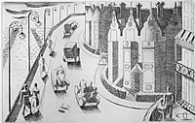
Edward Bawden, The Round Trip
The Round Trip (price if bought separately £750)
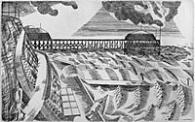
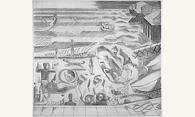
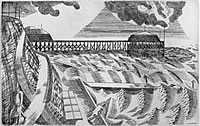
Edward Bawden, The Pier
The Pier (not available separately)

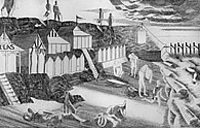
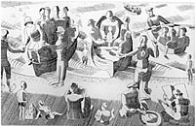
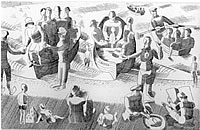
Edward Bawden, Southcliffe Beach
Southcliffe Beach (not available separately)
Edward Bawden, Marine Parade
Marine Parade (not available separately)

Edward Bawden, The Jetty Beach
The Jetty Beach (price if bought separately £750)
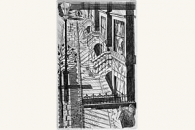
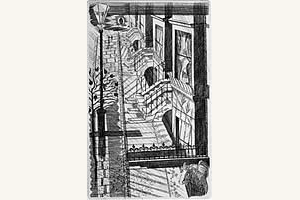
Edward Bawden,  Redcliffe Road
Redcliffe Road (price if bought separately £600)

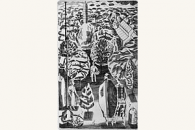
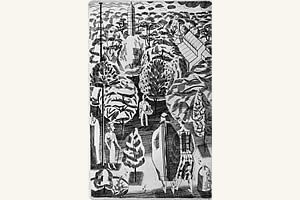
Edward Bawden, Kew Gardens
Kew Gardens (price if bought separately £450)
Edward Bawden, The Pagoda, Kew
The Pagoda, Kew (price if bought separately £450)

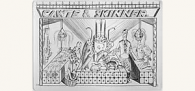
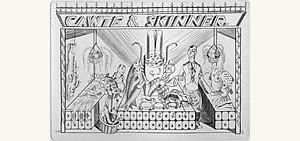
Edward Bawden, Fishmonger
Fishmonger (price if bought separately £750)
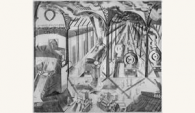
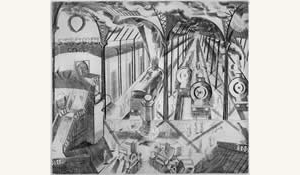
Edward Bawden, Liverpool Street Station
Liverpool Street Station (not available separately)

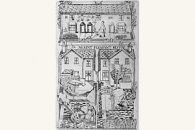
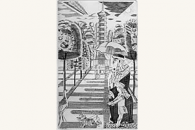
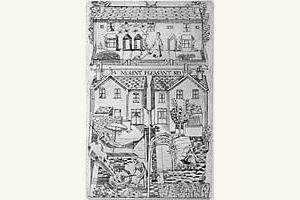
Edward Bawden, Mount Pleasant Road
Mount Pleasant Road (not available separately)
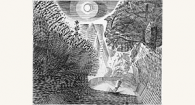
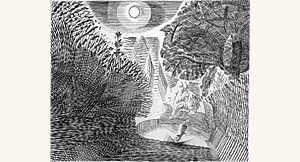
Edward Bawden,  Lane in Moonlight
Lane in Moonlight (not available separately)

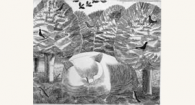
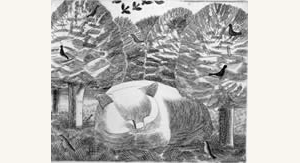
Edward Bawden, Reverie
Reverie (price if bought separately £400)
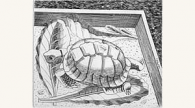
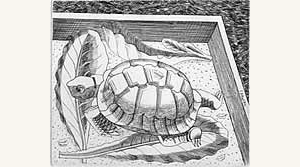
Edward Bawden, Tortoise
Tortoise (price if bought separately £400)

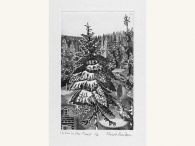
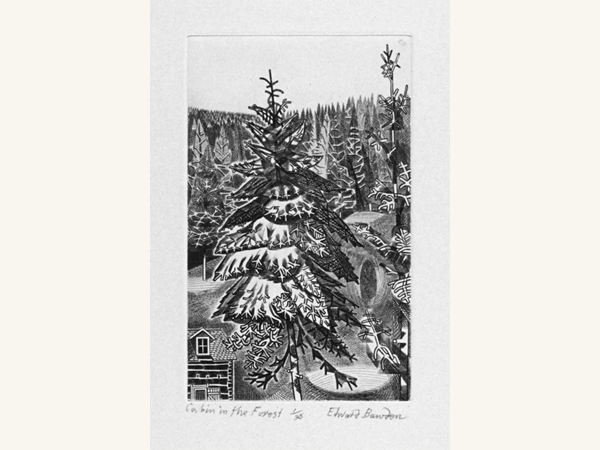
Edward Bawden, Cabin in the Forest
Cabin in the Forest £400 (not included in portfolio)

Details

This portfolio of previously little known line-engravings on copper was published in March 1988 to celebrate the eighty-fifth birthday of Edward Bawden. The occasion was marked by an exhibition of the engravings at the Victoria and Albert Museum. Two of them were subsequently shown in the British Museum exhibition Avant-garde British Printmaking 1914-1960.

The engravings were published in an edition of 35 copies (+5 artist's proofs). They were printed by Philip Bawden on 300gsm mould-made paper size 18"x15". Prints are signed, numbered, titled and dated by Edward Bawden. The set of engravings is presented in a hand made solander box covered with a Bawden patterned paper printed at the Curwen Press

There is one remaining complete portfolio available for sale at £12000.

Reprinted from the catalogue of the exhibition of 15 Engravings at the Victoria & Albert Museum, 1988

Introduction by David McKitterick

Between 1927 and 1929 Edward Bawden produced, quietly and principally for his friends, a series of copper line-engravings. He was then in his mid-twenties, back from Italy after his student days at the Royal College of Art, and was working in London to meet an endless variety of commissions. Water-colours and wall-papers jostled with line drawings and lino-cuts for Harold Curwen's publicity printing at the Curwen Press, and work with Eric Ravilious on the murals at Morley College. For all this time had to be found, as he also began to make excursions into yet another medium, line-engraving on copper.

Of all his work, these engravings are probably the least familiar. They were the result of his private interests, not of commissions. Scarcely any copies were sold, even of the few printed, when six were exhibited at the St. George's Gallery, near Hanover Square, in October 1927. Bawden's own records suggest that no more than forty at most have been printed of even the most popular.

Some of his other engravings, done on commission, were printed in much larger numbers. In July 1937 one accompanied an article by Graham Sutherland on 'Graven Images' in Signature which was then printed in editions of one thousand copies. Two further designs, executed in about 1952 for the Orient Line, are reproduced in Douglas Percy Bliss's monograph on Bawden, published in 1982; another is reproduced in John Lewis's Handbook of Type and Design (1956). These later engravings' much more finished in some respects than those of the twenties, bear little relation to his earlier work. They are relevant to his earlier designs because they show the way he eventually took forward. Read in that spirit, Bawden's remarks about line-engraving in John Lewis's book are not without interest:

Before beginning to work on the plates, I do a complete shaded pencil drawing of the design. I then make a simplified tracing, for there is no need to do a detailed tracing - unless for any reason a facsimile engraving of the original drawing is required. This tracing I transfer to the plate by means of ordinary (typewriter) carbon paper.

With this indication as a guide, and with the original drawing in front of me, I set to work to redraw the design, mainly with one tool, a square graver about one-tenth of an inch wide. This turns easily, raising little burr. It is similar to the tool that would be used for wood engraving, except that its face is cut at a steeper angle, to lessen the risk of the point breaking.

When working on a smooth copper plate, it is difficult to see how the design is developing; so at various stages I clean the plate with metal polish, leaving the polish in the engraved lines. This shows up quite clearly, though in fact, if one lays a piece of tracing paper over the engravings, the lines are revealed adequately. When the engraving is, as an imagine, finished, I proof it on a copperplate press, and then, if need be, re-proof.

If corrections have to be made, fine lines can be obliterated with a burnisher; more serious errors have to be planed off with a scraper. This may reduce the surface depth of the copper to such an extent that the back must be bumped up and small pieces of paper stuck on the back of the plate, exactly over the area that has been bumped.

Historically, line-engraving has had a poor press. For centuries, the wonderful range of possible tones that it offered made it an ideal vehicle for reproduction, until it was displaced by the development first of wood-engraving, and then of half-tone and other photographic processes in the latter part of the nineteenth century. These new methods were cheaper to prepare and, because they were letterpress, cheaper to print than engravings.

This essentially subservient role for line-engraving as a medium to record paintings, drawings, and even other intaglio images - has often meant relegation to only a very modest place in the hierarchy of intaglio processes. Not surprisingly, this was especially marked in the half-century following the development of commercial reproduction by photographic means from the 1870's onwards. Like wood-engraving, which was much more directly affected by the consequent revolution in block-making for printing, line-engraving fell into disfavour: even acknowledged masterpieces such as the steel-engravings after Turner's paintings became simply something of the past, rather than an incentive to the present.

It has taken more than a century for reproductive engraving to begin to creep back towards respectability, and for its impact to be assessed. In an article in Signature in 1937, Graham Sutherland, for one, was scathing:

Engravers, not content to reproduce their own engraved work, sought fresh fields to conquer in that they attempted to reproduce drawings and paintings. Both wood and metal engravings have been at various times prostituted in this way. It is interesting to reflect that, ignoble as was such an abuse of its original function, the actual engraving frequently became possessed of a charm and beauty which all too often the paintings which they sought to imitate did not possess. No form of engraving was ever meant to imitate a sunset, still less a painted one; yet so uncompromising is the medium that, when forced to such an odious duty, it will, while yielding the effect intended, retain its own inherent beauty!

So, in the early years of this century, those who are now remembered as intaglio artists concentrated on other processes: William Strang, Sir Charles Holroyd and F. L. Griggs following Alphonse Legros on etching; James MeBey, D.Y Cameron and Muirhead Bone on drypoint. Mezzotints became all the rage for collectors, the subject of major exhibitions and a still standard monograph by Cyril Davenport in 1904. Aquatints were the subject of a study, also unsuperseded, by S.T. Prideaux in 1909.

Much of contemporary taste, particularly in what may be termed establishment circles, was reflected not only in exhibitions, but also, perhaps especially, in Arthur M. Hind's great History of Engraving & Etching, first published in 1908. Hind, working in the Print Room of the British Museum, was in a position to be better informed than anyone else, even if he was not so apparently sympathetic to the work of his contemporaries as was his predecessor Campbell Dodgson, editor of The Print Collector's Quarterly.

The third edition of Hind's survey was published in 1923, when Bawden was a student in the School of Design at the Royal College of Art. As by then the standard work on the subject, Hind's words had some authority, and he concluded his section on line engraving with allusions to the two courses which he perceived in recent developments: one, taken by the Dutch engraver Pieter Dupont, the other, more adventurous, by William Strang, who had shown how it was possible to work a plate by drawing the burin towards one, rather than, more conventionally, pushing it constantly away. Even for the cautious Hind, the future seemed bright - either for the conventional or for the unconventional:

There would seem to be a fair field open to the artist who would return to the medium for original work, whether, like Dupont, he keeps to the old road, or with Mr Strang, broaches new methods whose history is still for the future.

More generally, and returning to the theme of his book as a whole, he closed his work by offering his own assessment of contemporary themes, the mêlée of
theories and tastes in the years following the First World War calling for the same conclusion as in 1908:

Engraving and etching have contributed far more than painting during the past hundred years to preserve the artist from mere anarchy, and it is in these fields that one looks for the expression, in which the uncertain streams and tendencies of modem art may crystallize.

Hind may be forgiven for his specialist professional opinion of the superiority of one medium over another.

When Bawden entered the Royal College of Art in 1922, there were separate schools for painting, design, decorative painting, engraving, and sculpture and modelling. As a member of the School of Design, he had little to do with the School of Engraving, presided over by the redoubtable Sir Frank Short. Etching, aquatint, and mezzotint were equally Short's forte, and in 1911 he had become the first engraver to be elected an RA. His skills were however not for Bawden, who failed to impress Short with his drawing ability. Encouragement and teaching came from elsewhere.

If Hind knew of the work of the French engraver J. E. Laboureur ( 1877 - 1943), he did not show it; yet it was Laboureur's presence that was most felt in England during the twenties, in a revival of interest in line-engraving. He was at the height of his powers as an engraver (his work was by no means limited to the medium) and at the centre of critical acclaim for those whose horizons were not limited to etchings or mezzotints. His work became eagerly collected during the decade, and he was sought after as a book illustrator - even for illustrations that, because they were intaglio, were costly to print.

Most of his work was published in France, where there was a tradition of the 'livre d'artisté', but he also had an informed following in England. Paul Nash, Bawden's mentor at the Royal College, was among the contributors in 1921 to The New Keepsake, edited by X.M. Boulestin and Laboureur himself. Also in 1921, at the instigation of Stanley Morison, Heinemann published a translation of Jacques Cazotte's The Devil in Love, with engravings by Laboureur. The following year Morison, as editor of The Fleuron, commissioned an article on him by Paul Istel:

M. Laboureur has successfully proved that engraving on copper and the printed type, far from being irreconcilable, lend themselves to harmonious association, when the illustrator, discarding the irregular biting of the etching, is satisfied with the purer lines of the burin. For the last twenty years, book collectors and publishers, repeating the Credo of Pelletan, have declared that wood is the only medium for illustration; exclusively interested in tone values, in sharp and powerful contrasts of black and white, they have forgotten that the combination of lines can be as attractive as the balance of colours.Other articles on Laboureur were less absorbed with the question paramount for The Fleuron, the tonal relationship of engraving to printed text. Campbell Dodgson, of the British Museum, was especially perceptive, and alert to Laboureur's wry humour, in an article on him in Artwork in 1925, and Yvonne Mareschal contributed an account of his engravings to Drawing & Design in 1927.

All this attention both encouraged and reflected revived interest in an all but discarded skill. Stephen Gooden's consciously archaic work harked back to the heyday of line-engraving in Britain in the seventeenth century, most successfully in his illustrations to the Nonesuch Press Anacreon in 1923. Edward Wadsworth produced a magical series of line engravings, coloured with pochoir, for Sailingships and Barges of the Western Mediterranean and Adriatic Seas, printed by the Curwen Press and A. Alexander & Sons in 1926. David Jones turned to the same medium for his series of illustrations to Aesop, published as a type specimen by the Monotype Corporation in 1928 and, on a larger scale, for the illustrations to The Rime of the Ancient Manner, published by Douglas Cleverclon in 1929. Gooden's reputation flowered, but David Jones's work passed largely ignored or misunderstood, to end up on the remainder tables a few years later.

This was the contemporary background against which Bawden worked, in a revival that came to an abrupt end when the depression forced such expensive books out of the market.

Having received no encouragement from Sir Frank Short at the Royal College, Bawden enrolled for a course taught by H. K. Wolfenden at the Sir John Cass Institute, in the City of London. Wolfenden was a trade engraver, specialising in lettering. Much of his work was in letter-heads and armorials; an unusually large example of his work can be seen in the frontispiece to Ambrose Heal's English Writing-masters and their Copy-books (Cambridge, 1931), one of several commissions he received thanks to Stanley Morison. For Bawden, however, Wolfenden had little to offer once he had taught the technical elements of engraving. The results of this instruction can be seen in the careful! lettering of 'Mount Pleasant Road', but generally Bawden preferred to go his own way.

The exhibition at the St. George's Gallery in 1927 was the first opportunity that Bawden, with his friends and fellow-students Eric Ravilious and Douglas Percy Bliss, had had to face the public. Six engravings were exhibited: 'The Jetty Beach', 'The Pier', 'Marine Parade', 'Southcliffe Beach', 'Reverie' and 'Tortoise'. The event was inspiriting, but the engravings, priced one guinea and twenty-five shillings, did not sell. The critics - where they noticed - were hesitant: one spoke of the trio's 'mild and formalised modernity', a phrase which pleased Ravilious but which shows little appreciation of Bawden's humour.

He did not exhibit his first engraving 'Cawte and Skinner', a fishmonger near South Kensington underground station felicitously renamed for the occasion. Two engravings, unlike the others, are versions of illustrations used in a book. The two engraved images of Kew Gardens appear, slightly differently, in Robert Herring's fantasy Adam and Evelyn at Kew, published by H. V. Marrot and Elkin Mathews in 1930. The book is illustrated by drawings printed from letterpress blocks, pochoir coloured in Holland. Unusually, and perhaps unfortunately, the book was written round the illustrations, which Bawden drew while a student at the Royal College. Nearly sixty years later, the illustrations have worn better than the text. Elkin Mathews was a firm of antiquarian and second-hand booksellers, whose tradition in publishing was kept alive by Marrot, a man extravagant alike in his private life and ideas for the firm. If there was ever any thought of publishing another version of this book, illustrated with engravings rather than line-blocks, nothing ever came of such an idea.

Most of the plates are distinctly domestic. They do not depend on larger literary or pictorial contexts. Characteristically, the subject matter is often drawn from the immediate surroundings of Bawden's own houses. 'Redcliffe Road' and 'London Back Garden' have as their subjects 58 Redcliffe Road, South Kensington, where Bawden and Ravilious shared lodgings while they were students and for some time afterwards. 'Mount Pleasant Road' is Bawden's fictionalised name for Woodfield Road in Braintree, Essex - the view is of Bawden's family home with his parents in their back garden. Liverpool Street Station, with its assembled steam engines, was the link between the two places.

These pictures belong in the same tradition as the watercolours painted in and around Bawden's house at Great Bardfield, done a few years later. The five seaside engravings also recall family life, childhood visits to Clacton on the Essex coast. They are not views in the conventional sense, but images selected and arranged as much with an eye to composition as to Bawden's memory. Place-names were changed, and there is little sign of the way in which Clacton developed into a crowded seaside resort within a couple of decades in the early part of this century. In the Clacton plates it is also especially instructive to compare Bawden's engraved line, scarcely cutting the surface of the copper in some passages, with his treatment of similar seaside themes in line drawings overprinted with colour for the L. N. E. R. booklet East Coasting by Dell Leigh, published in 1931 .

Other plates draw similarly on Bawden's memory. 'Lane in Moonlight' was inspired by Bawden's liking for night-time walks in the countryside around Black Notley, near the grave of the seventeenth-century naturalist John Ray, whose monument is the churchyard. 'Tortoise' recalls a pet he had possessed as a small boy. In 'Reverie' is the unmistakable Bawden image of the cat, omnipresent throughout his life and work.

Bawden's copper-engravings from this period were a private affair- private in allusion and private in that few people even knew of them. They represented a challenge to acquire a notoriously difficult skill, and the chance to explore the effects possible with an incised line rather than one drawn with the pen or brush They are very much records of an artist at work, and are therefore of especial interest. It is an extra bonus that they date from Bawden's first years of maturity.

David McKitterick

Edward Bawden, Engraving Edward Bawden, Engraving Edward Bawden, Engraving Edward Bawden, Engraving ...
Edward Bawden, Fifteen Engravings 1927 - 1929