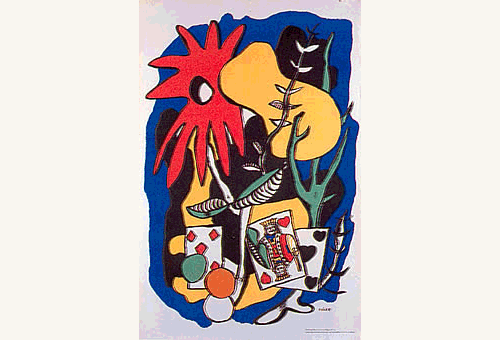
King Of Hearts, Fernand Léger
Check availability
Date
1949
Price
£800
Dimensions
860 × 497mm (30 × 19½ in)
Catalog number
SP25
In stock
Yes
Collection
About The Artist
Fernand Léger was born in Normandy and was apprenticed to an architect in Caen between 1897-1899. Between 1900 and 1904, he retouched photos in a photographic studio.
In 1903, he failed the entrance examination for the Ecole des Beaux-Arts and studied instead at the Ecole des Arts Decoratifs and the Académie Julian. From 1909 he was associated with the Cubists and became a member of the informal Puteaux Group two years later.
In 1913, he signed a contract with Daniel-H. Kahnweiler who had already discovered Picasso [Composition] and Braque [The Bird].
He was gassed during the First World War, and discharged in 1917 when he became a close friend of Le Corbusier and Ozenfant. He collaborated with Ozenfant in the Atelier Libre and in 1925 he exhibited at Le Corbusier's Pavilion de I'Esprit Nouveau.
During his collaboration with the leaders of the Purist movement his works exemplified the “machine aesthetic” which Purism exemplified. His paintings were static, with the precise and polished appearance of machinery, and he had a strong inclination for including representations of mechanical parts.
During the late 1920s and 1930s he also painted single objects isolated in space and sometimes amplified to gigantic size. He also produced theatrical decors, especially for the Swedish Ballets, and worked with the cinema. His Ballet Mechanic (1934) was the first film without a script.
During the Second World War Léger lived in the U.S and taught at Yale University and at Mills College, California. His painting at this time consisted of compositions featuring mainly acrobats and cyclists. After his return to France in 1945 his works reflected more prominently his political interest in the working classes. But their static, monumental style remained, with flat and pure colours, heavy black contours and a continuing concern with the contrast between cylindrical and rectilinear forms.
In 1949 he opened a studio for ceramics with his former pupil Robert Brice and made there his glass mosaics for the University of Caracas (1954). At the same time he was working on the windows and tapestries for the church at Audincourt (1951).
A Léger Museum was founded in his honour at Biot with large ceramic panels that he designed. Memorial retrospective exhibitions took place at the Musée des Arts Décoratifs, Paris, in 1956 and at the Haus der Kunst, Munich, in 1957. Léger had a considerable influence over many artists and was hailed as one of the greatest French painters of his time.